How AI Sales Assistants Increase Ecommerce Conversion Rates in 2026
Discover AI-powered conversational commerce that boosts ecommerce conversions.
Jul 30, 2026
5 mins
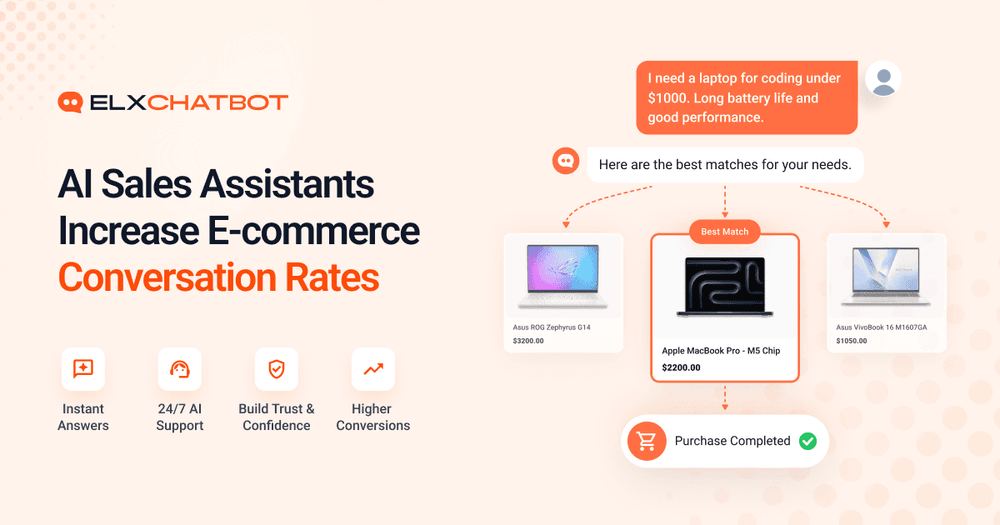
Ecommerce brands are increasingly using AI sales assistants to improve customer experience and increase conversion rates. These AI-powered systems do far more than answer support questions. They guide shoppers, recommend products, reduce friction during the buying journey, and help customers make faster purchasing decisions. In this article, we explore how AI sales assistants are transforming ecommerce in 2026.
One of the biggest challenges in ecommerce is turning website visitors into paying customers.
Most online stores attract traffic successfully, but many struggle with:
- Low conversion rates
- High bounce rates
- Cart abandonment
- Poor product discovery
- Overwhelmed customer support teams
In many cases, customers leave not because they are uninterested, but because they cannot quickly find the right answers or products.
This is where AI sales assistants are changing ecommerce.
Modern AI-powered shopping assistants are helping brands create faster, more personalised, and more conversational buying experiences that significantly improve conversion rates.
What Is an AI Sales Assistant?
An AI sales assistant is an intelligent conversational system designed to help customers throughout the buying journey.
Unlike traditional support chatbots that mainly answer FAQs, AI sales assistants actively help customers make purchasing decisions.
They can:
- Recommend products
- Answer product-related questions
- Guide shoppers towards suitable options
- Compare products
- Provide instant support
- Personalise recommendations
- Assist during checkout
- Reduce customer hesitation
In many ways, AI sales assistants function like digital in-store sales advisors.
Why Ecommerce Conversion Rates Are Often Low
Many ecommerce websites still rely heavily on:
- Static product pages
- Complicated navigation
- Manual product discovery
- Generic search functionality
- Delayed customer support
This creates friction during the customer journey.
Shoppers often leave because:
- They cannot find suitable products
- They feel overwhelmed by too many choices
- They have unanswered questions
- They lack confidence before purchasing
- Support is unavailable when needed
Every moment of uncertainty increases the risk of losing a sale.
AI Sales Assistants Reduce Buying Friction
One of the biggest advantages of AI sales assistants is their ability to remove friction from the buying process.
Instead of forcing customers to search manually, AI assistants create conversational shopping experiences.
For example, a customer might say:
“I need a lightweight laptop for travel and work.”
The AI assistant can then:
- Ask follow-up questions
- Narrow down recommendations
- Explain differences between products
- Suggest the best options instantly
This makes the shopping journey significantly easier and faster.
Personalised Product Recommendations Increase Conversions
Product recommendation quality has a major impact on ecommerce sales.
Traditional recommendation systems often rely on:
- Basic product categories
- Browsing history
- “Related products” sections
AI sales assistants provide much more intelligent recommendations because they can understand customer intent through conversation.
They can personalise suggestions based on:
- Customer preferences
- Use cases
- Budgets
- Product requirements
- Previous responses
This creates far more relevant product recommendations.
Customers are much more likely to convert when they feel products are tailored to their needs.
AI Sales Assistants Help Customers Make Decisions Faster
Modern ecommerce stores often offer hundreds or thousands of products.
Too much choice can overwhelm customers and delay purchasing decisions.
AI sales assistants simplify this process by:
- Narrowing product options
- Explaining key differences
- Answering objections instantly
- Providing reassurance
- Helping customers feel confident
This reduces decision fatigue and encourages faster purchases.
Instant Responses Keep Customers Engaged
Customers increasingly expect immediate support while shopping online.
If questions remain unanswered, many shoppers leave the website entirely.
AI sales assistants provide:
- Instant answers
- Real-time support
- 24/7 availability
- Conversational guidance
This helps maintain customer engagement during critical moments of the buying journey.
AI Sales Assistants Reduce Cart Abandonment
Cart abandonment remains one of the biggest problems in ecommerce.
Customers frequently abandon purchases because of concerns such as:
- Shipping costs
- Delivery times
- Sizing uncertainty
- Product suitability
- Return policies
AI-powered assistants can proactively address these concerns before customers leave.
For example, the AI can:
- Answer delivery questions instantly
- Explain return policies
- Recommend alternative sizes
- Provide product clarification
- Offer assistance during checkout
This helps improve customer confidence and reduce abandoned carts.
Also Read: How AI Sales Assistants Reduce Cart Abandonment
Conversational Commerce Feels More Natural
Consumers are becoming increasingly comfortable interacting with AI conversational systems.
Messaging platforms, voice assistants, and tools like ChatGPT have changed customer expectations.
People now expect digital experiences to feel:
- Conversational
- Personalised
- Responsive
- Interactive
AI sales assistants align perfectly with this behavioural shift. Instead of navigating static ecommerce experiences, customers can simply describe what they need naturally. This creates a more engaging shopping experience.
Why Ecommerce Websites Are Becoming Conversational Experiences in 2026
AI Sales Assistants Improve Customer Experience
Customer experience is now one of the biggest competitive advantages in ecommerce.
AI sales assistants help improve customer experience by:
- Reducing frustration
- Simplifying shopping journeys
- Providing personalised assistance
- Improving support accessibility
- Helping customers find products faster
Customers who enjoy smoother shopping experiences are more likely to:
- Complete purchases
- Return in the future
- Recommend the brand to others
AI Sales Assistants Help Support Teams Operate More Efficiently
AI sales assistants do not replace human support teams entirely.
Instead, they reduce pressure by handling:
- Repetitive questions
- Product discovery
- Order status queries
- Common support requests
This allows human agents to focus on:
- Complex customer issues
- Escalations
- Relationship building
- Higher-value interactions
The result is a more scalable support operation.
Multilingual AI Assistants Help Global Ecommerce Brands
International ecommerce growth often creates support challenges across multiple languages.
AI sales assistants can:
- Automatically detect customer languages
- Communicate naturally across regions
- Provide consistent support globally
This helps ecommerce businesses expand internationally while maintaining strong customer experiences.
Ecommerce Brands Are Using AI Beyond Customer Support
One of the biggest shifts happening in ecommerce is that AI systems are no longer viewed purely as support tools.
AI sales assistants are now helping brands:
- Increase revenue
- Improve conversions
- Enhance product discovery
- Personalise customer journeys
- Strengthen customer engagement
The line between customer support and sales assistance is rapidly disappearing.
What Ecommerce Brands Should Look For in AI Sales Assistants
As AI shopping technology evolves, businesses should prioritise platforms that offer:
Intelligent Product Recommendations
The AI should understand product data and customer intent deeply.
Ecommerce Platform Integration
Integration with Shopify, Magento, WooCommerce, and BigCommerce is essential.
Real-Time Order Support
Customers increasingly expect instant order tracking and delivery information.
Human Handover
Businesses should be able to step into conversations seamlessly when needed.
Analytics and Conversion Insights
Tracking conversations, customer behaviour, and conversion trends is critical.
Multilingual Support
Global brands require AI systems capable of communicating naturally across multiple languages.
AI Sales Assistants Are Becoming Essential for Ecommerce
As ecommerce competition increases, brands are looking for ways to create more personalised and efficient shopping experiences.
AI sales assistants help businesses:
- Guide customers more effectively
- Reduce friction
- Improve support responsiveness
- Increase conversion rates
- Scale customer engagement
What was once considered an optional feature is quickly becoming an expected part of the online shopping experience.
Final Thoughts
AI sales assistants are transforming ecommerce from static online browsing into conversational, personalised shopping experiences.
By helping customers discover products, answer questions instantly, and reduce buying hesitation, AI-powered assistants are becoming powerful conversion optimisation tools.
For ecommerce brands, the opportunity goes beyond support automation. The real value lies in creating intelligent shopping experiences that help customers move from interest to purchase more quickly and confidently.
As customer expectations continue to evolve in 2026, AI sales assistants are likely to become one of the most important technologies driving ecommerce growth.
More Blogs
Explore more insights, tips, and stories from our team.