Can AI Chatbots Help Customers Find the Right Auto Parts?
Discover How AI Improves Parts Fitment, Product Discovery, and Automotive Ecommerce Sales
Oct 21, 2026
5 mins
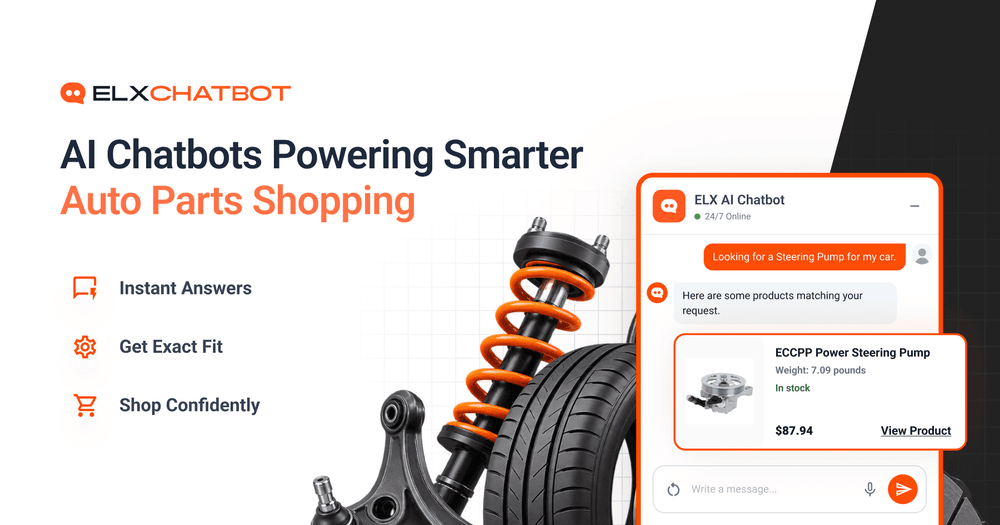
Discover how AI chatbots transform automotive parts ecommerce with vehicle-based product discovery, fitment assistance, product comparisons, and automated support.
Buying automotive parts online can be surprisingly complicated.
A customer may know that their vehicle needs new brake pads, an air filter, a battery, or a replacement component. But knowing the problem is only the beginning.
They may still need to determine:
- Vehicle make and model
- Model year
- Engine
- Trim
- Drivetrain
- Part number
- Dimensions
- Specifications
- Brand
- Compatibility
- Price
One incorrect part can mean a failed installation, a delayed repair, an unnecessary return, and a frustrated customer.
That's what makes automotive parts ecommerce particularly well suited to conversational AI.
Instead of asking customers to search through thousands of technical product listings, an AI shopping assistant can help them describe what they need, collect relevant vehicle information, narrow down compatible products, explain specifications, compare options, and answer support questions.
For automotive parts retailers, the opportunity is bigger than simply adding a chatbot.
It's about making a complex product catalogue easier to shop.
Why Automotive Parts Ecommerce Needs Better Product Discovery
Automotive parts catalogues can contain thousands of products that look similar but aren't necessarily interchangeable.
A shopper searching for brake components, filters, batteries, lighting products, suspension parts, or accessories may encounter dozens of options.
Traditional ecommerce search assumes that customers know what they're looking for. But many shoppers don't.
They may know:
I need front brake pads for my 2022 Honda Civic.
Or:
I need a replacement air filter for my car.
The customer understands the job. They may not know the exact product name, SKU, or part number.
Conversational AI changes the starting point.
Instead of requiring the customer to translate their need into ecommerce search terminology, the chatbot can ask relevant questions and guide them toward products in the retailer's catalogue.
1. AI Turns Auto Parts Discovery Into a Conversation
Automotive shoppers often describe a repair requirement rather than a product.
For example:
I need new brake pads for my car.
An AI assistant can ask for information such as:
- Make
- Model
- Year
- Engine
- Trim
Other relevant vehicle details
It can then narrow down the products available in the store.
This creates a more natural path from vehicle → requirement → compatible products.
The customer doesn't need to know the exact catalogue terminology before starting the conversation.
ELX Chatbot's product recommendation capabilities are designed to help shoppers discover relevant products based on customer intent and store catalogue information.
Internal link: AI Product Recommendations with ELX Chatbot
2. Vehicle-Based Recommendations Can Make Product Selection Easier
Automotive parts recommendations often depend on vehicle-specific information.
Relevant data can include:
- Make
- Model
- Model year
- Engine
- Trim
- Drivetrain
- Part specifications
- Existing part number
A conversational assistant can collect this information before presenting products.
For example:
I drive a 2021 Ford F-150 with the 3.5L EcoBoost. I need replacement brake pads.
Instead of returning every brake pad in the catalogue, the AI can use the information provided to narrow the search.
The important caveat is fitment accuracy.
The chatbot should only make a compatibility recommendation when the required vehicle and product data is available.
If the system cannot verify fitment, it should say so rather than guessing.
That distinction is critical in automotive ecommerce.
3. VIN-Based Shopping Can Add Another Layer of Vehicle Identification
For some automotive stores, VIN information can provide another way to identify a vehicle.
NHTSA describes a VIN as a 17-character vehicle identification number and provides an official VIN Decoder that can retrieve vehicle information reported by the manufacturer.
A retailer with an appropriate fitment system could use VIN-related information as part of its broader vehicle-identification workflow.
However, the chatbot itself should not be treated as the authoritative source of fitment data.
The safest model is:
VIN or vehicle details → verified fitment data → product recommendation
rather than:
VIN → AI guess → product recommendation
This distinction helps protect both customer trust and the retailer from avoidable incorrect-part purchases.
4. AI Can Help Reduce Incorrect Parts Purchases
Buying the wrong automotive part creates problems for everyone.
The customer may receive something that:
- Doesn't fit the vehicle
- Has the wrong dimensions
- Uses the wrong connection
- Doesn't meet the required specification
- Doesn't match the required part number
- Isn't compatible with another component
The result can be:
Return → Replacement → Shipping delay → Customer frustration
An AI assistant can reduce this risk by asking relevant questions before recommending a product.
For example:
What year and engine does your vehicle have?
That single question may eliminate a large number of irrelevant products.
But again, the AI should only make a definitive fitment recommendation when the underlying data supports it.
5. AI Makes Technical Automotive Information Easier to Understand
Automotive parts can contain specifications that aren't immediately clear to every shopper.
A product page might include:
- Dimensions
- Materials
- Capacity
- Power
- Flow rate
- Electrical specifications
- Compatibility
- Performance characteristics
Experienced mechanics may understand these immediately.
Everyday vehicle owners may not.
A conversational AI assistant can explain technical information in simpler language using the retailer's verified product data.
For example:
What's the difference between these two batteries?
Or:
What does this filter specification mean?
The chatbot can explain the relevant information without requiring customers to research every technical term themselves.
This makes a complex catalogue more accessible to both professional and consumer buyers.
6. AI Makes Automotive Parts Comparison Faster
Automotive customers often compare multiple brands or product versions before purchasing.
They may ask:
What's the difference between these brake pads?
Which battery is suitable for my vehicle?
What's the difference between these two filters?
Is this part equivalent to the original?
Which option offers the best value?
An AI assistant can summarize the differences using the information available in the retailer's product catalogue. Instead of switching between multiple product pages, customers can ask the comparison question directly.
The comparison can also be tailored to the customer's goal.
For example:
Which of these brake pads is the better option for daily driving?
The chatbot can focus the response on the relevant specifications available in the store.
7. AI Can Recommend Complementary Parts and Accessories
Automotive repairs rarely involve only one product.
A customer purchasing one component may also need:
- Installation accessories
- Complementary parts
- Tools
- Maintenance products
- Replacement hardware
Conversational AI can identify these opportunities from the customer's shopping intent.
For example:
If you're replacing this component, would you like to see the compatible installation accessories?
That is more useful than displaying unrelated products.
Relevant recommendations can help customers complete their shopping in one place while creating opportunities to increase average order value.
ELX Chatbot supports AI-powered product recommendations designed around customer needs, preferences, and available store products.
8. AI Can Help Reduce Cart Abandonment
Automotive shoppers may add a part to their cart and then hesitate because they're unsure about:
- Fitment
- Specifications
- Delivery
- Warranty
- Returns
- Availability
An unanswered compatibility question can be enough to stop a purchase.
An AI assistant can address these questions while the customer is still on the site.
For example:
Does this brake pad fit my vehicle?
If the store has verified fitment information, the chatbot can provide the relevant answer.
If it doesn't, the chatbot should explain that fitment cannot be confirmed and offer a human handoff or direct the customer to the appropriate verification process.
ELX Chatbot is positioned as a conversational sales assistant that can answer purchase questions, recommend products, and help reduce friction during the buying journey.
Learn More: How Chatbots Turn Conversations Into Sales
9. 24/7 Customer Support for Auto Parts Stores
Automotive customers don't necessarily shop during traditional business hours.
A customer working on their vehicle in the evening may suddenly need to know:
Is this part available?
Does it fit my vehicle?
When can it ship?
What is the return policy?
What warranty applies?
Where is my existing order?
An AI chatbot can provide immediate answers to many routine questions.
ELX Chatbot provides automated support for product questions, FAQs, order status, shipping, returns, and other common ecommerce requests.
This allows human support teams to focus on more complex technical or customer situations.
10. Real-Time Order Tracking Reduces Repetitive Support Requests
After purchasing a part, customers usually want to know when it will arrive.
This can be especially important when a vehicle is already waiting for repair.
Customers may ask:
Has my order shipped?
When will the parts arrive?
Can I track my package?
An ecommerce-connected chatbot can provide order status and shipping information without requiring a support agent to manually check every request.
ELX Chatbot supports real-time order-status assistance as part of its ecommerce feature set.
Find More: ELX Chatbot Features
11. Multilingual Support Helps Global Automotive Retailers
Automotive parts ecommerce increasingly serves customers across multiple countries and languages.
A multilingual AI assistant can help customers with:
- Product discovery
- Vehicle-related questions
- Product information
- Shipping
- Order tracking
- Returns
ELX Chatbot supports multilingual customer assistance, allowing ecommerce businesses to provide support across different markets without requiring a separate support team for every language.
For international automotive retailers, this can make support more scalable.
12. AI Can Support Professional Automotive Buyers
Automotive parts ecommerce isn't limited to individual vehicle owners.
Professional customers may include:
- Workshops
- Mechanics
- Dealerships
- Fleet operators
- Parts resellers
These customers may place frequent orders and already understand automotive terminology.
Their challenge is often speed.
They need to find the right part quickly.
A conversational AI assistant can help them locate products, compare alternatives, answer routine catalogue questions, and find related parts.
For example:
I need the replacement filter for this vehicle. Show me the available options
Or:
Compare the three compatible brake pad brands
For larger B2B operations, conversational AI can complement rather than replace account managers and specialist sales teams.
13. AI Can Turn a Vehicle Problem Into a Guided Shopping Journey
One of the most useful differences between conversational search and traditional ecommerce search is that customers can begin with a problem.
For example:
My car needs a replacement air filter.
I need new brake pads.
I'm replacing a damaged lighting component.
The customer doesn't necessarily need to know the product category.
The chatbot can collect vehicle information, understand the request, and guide the shopper toward relevant products.
This creates a simple journey:
Vehicle → Need → Fitment → Product → Purchase
That is a much more natural experience for many automotive shoppers.
14. AI Can Help Customers Understand OEM and Aftermarket Options
Automotive shoppers often compare different brands or replacement options.
They may want to understand:
- Original equipment options
- Aftermarket alternatives
- Brand differences
- Product specifications
- Warranty information
- Price differences
An AI assistant can explain the differences using the retailer's verified product information.
However, it should avoid making unsupported claims such as saying an aftermarket product is always equivalent to an OEM component.
For emissions-related components in particular, retailers need to be careful about compliance.
The U.S. EPA states that federal law prohibits aftermarket parts or devices that bypass or defeat required vehicle emissions controls.
So an AI assistant should rely on the retailer's verified compliance and product information rather than making broad claims about legality or equivalence.
15. AI Conversations Can Reveal Automotive Customer Demand
A chatbot doesn't just answer questions.
It can also reveal what customers are struggling to find.
Automotive retailers can analyse conversations to identify:
- Frequently requested parts
- Common fitment questions
- Popular brands
- Product comparison trends
- Common purchase objections
- Missing catalogue information
- Frequently requested accessories
These insights can improve:
- Product descriptions
- Catalogue structure
- Search
- Merchandising
- Inventory planning
- Support content
For example, if customers repeatedly ask whether a particular part fits a specific vehicle, that could indicate an opportunity to improve the product page's fitment information.
ELX Chatbot includes analytics that help businesses review conversations, customer questions, link clicks, order-related queries, and handoffs.
Learn How to Continuously Improve Conversation Performance
Best Practices for Automotive Parts Ecommerce AI
1. Prioritize Fitment Accuracy
This should be the number-one rule.
An automotive chatbot should never confidently recommend a part when compatibility cannot be verified.
Use reliable information for:
- Make
- Model
- Year
- Engine
- Trim
- Drivetrain
- Part number
- Product specifications
If the information is insufficient, ask another question or hand the customer to a specialist.
2. Connect the Chatbot to Current Product Data
The AI should work from current:
- Product specifications
- Inventory
- Pricing
- Part numbers
- Compatibility information
- Product URLs
Outdated catalogue information can result in incorrect recommendations.
ELX Chatbot connects to ecommerce product data and uses store information to power product discovery and recommendations.
For more on the importance of accurate ecommerce AI, see 5 Factors That Make or Break Ecommerce AI Chatbot Performance.
3. Ask the Right Vehicle Questions
Don't ask customers for information you don't need.
Collect the details required to narrow down the product.
Depending on the part, that may include:
- Make
- Model
- Year
- Engine
- Trim
- Drivetrain
- Existing part number
A well-designed conversation should feel efficient rather than like filling out a technical form.
4. Make Technical Information Easy to Understand
Don't simply repeat specifications.
Explain what they mean in the context of the customer's purchase.
For example:
This battery has a higher capacity than the other option, but both are listed as compatible with your vehicle.
The goal is to make technical information actionable.
5. Never Guess Fitment
This deserves repeating.
If the chatbot doesn't have enough information to verify compatibility, it should say so.
An incorrect confident answer is worse than admitting uncertainty.
6. Keep Human Handover Available
Some automotive questions require specialist knowledge.
Customers should be able to speak with an experienced support agent when:
- Fitment is unclear
- The product is highly technical
- A customer has a complex repair requirement
- A professional buyer needs account-specific assistance
ELX Chatbot supports live agent handoff so teams can take over conversations when necessary.
7. Keep Product Information Updated
The AI can only be as accurate as the information it receives.
Regularly review:
- Compatibility data
- Product specifications
- Pricing
- Inventory
- Part numbers
- Returns
- Warranty information
For automotive ecommerce, stale product data can directly translate into incorrect recommendations.
How ELX Chatbot Supports Automotive Parts Ecommerce
ELX Chatbot combines conversational shopping assistance with automated ecommerce customer support.
For automotive parts retailers, relevant capabilities include:
- AI-powered product recommendations
- Conversational product discovery
- FAQ automation
- Multilingual support
- Real-time order tracking
- Human handoff
- Ecommerce platform integrations
- Analytics and customer insights
ELX's current platform supports Shopify, BigCommerce, Adobe Commerce, WooCommerce, and custom ecommerce setups.
The broader ELX approach is to connect the chatbot to the ecommerce environment so it can use product information, FAQs, and order data rather than operating as a generic standalone chatbot.
ELX Chatbot for Shopify Automotive Parts Stores
Shopify automotive retailers can use ELX Chatbot to provide:
- Product recommendations
- Product discovery
- FAQ assistance
- Shipping information
- Availability questions
- Order tracking
- Human handoff
The Shopify integration connects the chatbot with store product and order information and includes analytics for conversations, recommendations, and customer engagement.
ELX Chatbot for Shopify Stores
ELX Chatbot for WooCommerce Automotive Parts Stores
WooCommerce parts retailers can connect ELX Chatbot with their ecommerce store to provide conversational product discovery and automated customer assistance.
ELX Chatbot for WooCommerce Stores
ELX Chatbot for BigCommerce Automotive Parts Stores
BigCommerce automotive retailers can use ELX Chatbot to help customers discover products, answer questions, compare options, and receive order assistance.
ELX Chatbot for BigCommerce Stores
ELX Chatbot for Adobe Commerce Automotive Retailers
Adobe Commerce stores can connect ELX Chatbot with their ecommerce environment to automate product and customer-support conversations.
ELX Chatbot for Adobe Commerce Stores
From Automotive Chatbot to AI Parts Assistant
The future of automotive ecommerce isn't simply about adding a chat bubble to a website.
It's about helping customers navigate increasingly complex product catalogues.
The ideal experience looks more like:
Tell us your vehicle → Explain what you need → Verify fitment → Compare products → Choose → Purchase → Track
This is where conversational AI can provide real value.
It turns a complicated catalogue into a guided shopping experience.
ELX Chatbot's broader ecommerce capabilities combine product recommendations, automated support, order tracking, multilingual assistance, analytics, and human handoff.
For a broader look at how ecommerce chatbots are evolving from simple responders into task-oriented assistants, see The Rise of Task-Oriented Chatbots
The Future of Automotive Parts Shopping Is Conversational
Automotive parts shoppers don't always start with a product name.
They may start with:
A vehicle
I have a 2021 Toyota Camry.
A problem
I need to replace my brake pads.
A requirement
I need a battery for this vehicle.
A comparison
Which of these two parts is better?
Conversational AI can connect those starting points to relevant products and information.
Instead of asking customers to understand a complicated parts catalogue, retailers can allow them to explain what they need naturally.
The AI can then guide them through the shopping process.
Final Thoughts
Automotive parts ecommerce is fundamentally different from selling simple consumer products.
Customers need confidence that a part is appropriate for their vehicle, specifications, and intended use.
That makes conversational AI particularly valuable.
An effective AI shopping assistant can help customers:
- Discover parts conversationally
- Identify products using vehicle information
- Understand technical specifications
- Compare brands and products
- Find complementary parts
- Reduce uncertainty before checkout
- Get 24/7 customer support
- Track orders
- Receive multilingual assistance
- Connect with human specialists
The most important principle is accuracy.
An automotive chatbot should never guess fitment.
When reliable vehicle and product data are available, conversational AI can make complex automotive catalogues much easier to navigate.
For automotive parts retailers, that can mean less purchase friction, fewer repetitive support questions, better product discovery, and a more efficient ecommerce experience.
Ready to make your automotive parts store easier to shop?
Explore ELX Chatbot to see how AI-powered product recommendations, automated customer support, order tracking, and conversational shopping can work for your ecommerce store.
You can also explore ELX Chatbot's features or view ELX Chatbot pricing.
More Blogs
Explore more insights, tips, and stories from our team.