Ecommerce AI Chatbot Statistics 2026: 50+ Facts Every Online Retailer Should Know
50+ Ecommerce AI Chatbot Statistics, Trends, and Facts Retailers Need to Know
Aug 18, 2026
5 mins
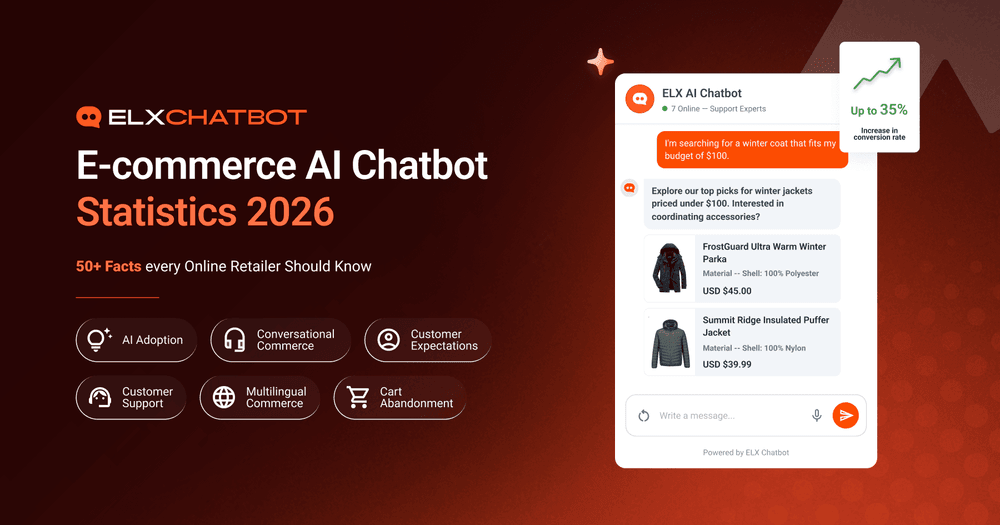
Artificial intelligence is rapidly transforming ecommerce, from customer support and product discovery to personalised shopping experiences. Businesses adopting AI chatbots are seeing improvements in customer satisfaction, operational efficiency, and sales performance. This article brings together some of the most important ecommerce AI chatbot statistics for 2026 to help retailers understand why conversational AI has become a strategic investment.
Artificial intelligence has moved from being an emerging technology to becoming a competitive advantage for ecommerce businesses.
Today's consumers expect immediate answers, personalised product recommendations, and seamless shopping experiences. AI chatbots help retailers meet these expectations while improving operational efficiency and driving revenue growth.
The following statistics highlight why conversational AI is becoming a core component of modern ecommerce.
AI Adoption Statistics
Artificial intelligence adoption continues to accelerate across industries, with retail among the fastest-growing sectors.
Key Statistics
- More than 75% of organisations now use AI in at least one business function.
- Retail and ecommerce remain among the leading industries investing in generative AI.
- AI investment continues to increase as businesses seek greater operational efficiency.
- Customer service and sales are among the most common AI use cases.
Why it matters
AI is becoming mainstream. Businesses delaying adoption risk falling behind competitors that are already using AI to improve customer experiences.
Customer Expectations Statistics
Modern shoppers expect speed and convenience throughout the buying journey.
Key Statistics
- Around 80% of customers consider the experience a company provides to be as important as its products or services.
- Most online shoppers expect businesses to respond quickly to customer inquiries.
- Customers increasingly prefer self-service options when they need simple information.
- Personalised shopping experiences strongly influence purchasing decisions.
Why It Matters
Customer experience has become a major competitive differentiator. AI chatbots help businesses meet these expectations at scale.
Conversational Commerce Statistics
Shopping is becoming increasingly conversational.
Instead of browsing through multiple product pages, customers increasingly prefer natural interactions.
Key Statistics
- Conversational commerce is projected to continue growing rapidly over the coming years.
- AI-powered shopping assistants are becoming common across ecommerce websites.
- More retailers now use AI to assist with product recommendations and customer engagement.
- Consumers increasingly interact with brands through conversational interfaces.
Why it matters
Customers want guidance—not just search bars. Conversational shopping creates more engaging buying experiences.
Customer Support Statistics
Customer service remains one of the largest AI investment areas.
Key Statistics
- Customer support teams spend a significant portion of their time answering repetitive enquiries.
- AI chatbots can automate a large percentage of routine customer questions.
- Businesses using AI often report faster response times and improved operational efficiency.
- 24/7 availability is one of the most valued chatbot capabilities.
Why it matters
Automating repetitive conversations allows support teams to focus on more complex customer needs.
Conversion Rate Statistics
AI chatbots don't just answer questions—they help customers complete purchases.
Key Statistics
- Personalised recommendations improve purchase likelihood.
- Faster customer responses reduce buying friction.
- Conversational shopping helps customers discover relevant products more efficiently.
- Businesses implementing AI-assisted shopping often report measurable conversion improvements.
Why it matters
Every unanswered customer question represents a potential lost sale.
AI helps remove obstacles that prevent customers from completing purchases.
Cart Abandonment Statistics
Cart abandonment continues to challenge ecommerce businesses.
Key Statistics
- Global cart abandonment rates remain close to 70% across ecommerce.
- Unexpected costs and unanswered questions remain major reasons customers abandon purchases.
- Real-time customer assistance helps reduce abandonment.
- Personalised support encourages customers to complete checkout.
Why it matters
Even small improvements in cart recovery can generate substantial additional revenue.
Personalisation Statistics
Customers increasingly expect retailers to understand their preferences.
Key Statistics
- Most consumers are more likely to purchase from brands offering personalised experiences.
- Personalised recommendations improve customer engagement.
- Relevant product suggestions increase average order value.
- Personalisation strengthens customer loyalty and repeat purchasing.
Why it matters
AI enables personalised shopping experiences without requiring manual customer support.
Multilingual Commerce Statistics
Cross-border ecommerce continues to expand.
Key Statistics
- International ecommerce sales continue growing each year.
- Customers prefer purchasing from websites available in their own language.
- Multilingual customer support improves accessibility and customer satisfaction.
- AI makes multilingual support significantly more scalable.
Why it matters
Language should never become a barrier to purchasing.
Operational Efficiency Statistics
Businesses increasingly use AI to improve productivity.
Key Statistics
- AI reduces repetitive administrative tasks.
- Customer support automation lowers operational costs.
- AI enables businesses to scale customer service without proportionally increasing headcount.
- Productivity gains allow employees to focus on higher-value work.
Why it matters
AI creates value by improving both efficiency and customer experience.
Customer Loyalty Statistics
Long-term business growth depends on customer retention.
Key Statistics
- Retaining existing customers generally costs less than acquiring new ones.
- Positive customer experiences encourage repeat purchases.
- Fast support improves customer satisfaction.
- Personalisation strengthens long-term customer relationships.
Why it matters
Customer loyalty is one of the strongest drivers of sustainable ecommerce growth.
What These Statistics Mean for Ecommerce Businesses
Looking across the data, several clear trends emerge.
Successful ecommerce businesses are increasingly investing in AI because it helps them:
- Automate customer support
- Improve product discovery
- Increase conversion rates
- Reduce cart abandonment
- Personalise shopping experiences
- Lower operational costs
- Improve customer satisfaction
- Strengthen customer loyalty
Rather than replacing human teams, AI enables businesses to deliver better experiences while operating more efficiently.
How ELX Chatbot Helps Ecommerce Businesses
ELX Chatbot is designed specifically for ecommerce brands looking to take advantage of these growing AI trends.
Its capabilities include:
- AI-powered product recommendations
- Conversational shopping assistance
- Real-time order tracking
- Multilingual customer support
- Seamless human handover
- Integrations with leading ecommerce platforms
- Analytics and customer insights
By combining customer support automation with conversational sales assistance, ELX Chatbot helps businesses improve both operational performance and revenue generation.
Preparing for the Future of Ecommerce
Artificial intelligence is no longer an experimental technology for ecommerce—it is becoming part of the standard customer experience.
Consumers increasingly expect websites to provide:
- Immediate assistance
- Personalised recommendations
- Natural conversations
- Real-time order updates
- Support available around the clock
Businesses that invest in conversational AI today will be better positioned to meet these expectations while scaling more efficiently.
Final Thoughts
The latest ecommerce AI chatbot statistics highlight a clear direction for online retail.
Customers want faster, more personalised, and more convenient shopping experiences. Businesses want greater efficiency, lower support costs, and stronger conversion rates.
AI chatbots help bridge these goals by combining intelligent customer support with conversational commerce.
As AI adoption continues to grow throughout 2026 and beyond, ecommerce businesses that embrace conversational AI will be better equipped to compete, innovate, and build lasting customer relationships.
More Blogs
Explore more insights, tips, and stories from our team.