Cart Abandonment in 2026: Why 7 in 10 Carts Are Left Behind and How an AI Chatbot Helps
Cart Abandonment in 2026: How AI Chatbots Help Recover Sales
Nov 3, 2026
5 mins
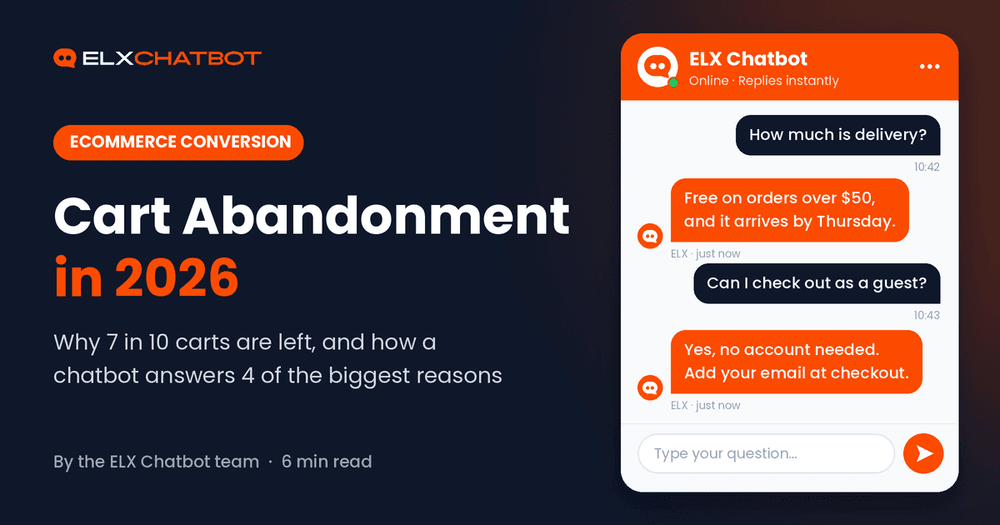
Cart abandonment remains a major challenge for ecommerce businesses, with research placing the average rate at around 70%. This guide examines four common reasons shoppers leave without buying: unexpected shipping costs, forced account creation, slow delivery, and checkout complexity. It explains where an AI chatbot can help by answering questions about delivery, product choices, returns, and payment methods, while clarifying what only store-level changes can fix. You’ll also find a practical revenue example and steps to measure whether chatbot conversations improve conversions on your store, without relying on vendor claims.
The 70% problem
Most shoppers who add something to their cart never buy it. Baymard Institute's 2026 benchmark, which averages 50 studies, puts the average cart abandonment rate at 70.22%. Baymard also estimates that about $260 billion in lost orders in the US and EU could be recovered through better checkout design alone.
Conversion rates point the same way. Industry estimates put average ecommerce conversion at roughly 2.5% to 3.3%, with mobile lower at about 1.8% to 2.8%. Figures vary by source and sector, so treat them as a rough guide. Either way, most visitors leave without buying.
A chatbot cannot fix every cause. But some shoppers leave because a question about cost, delivery or returns went unanswered, and those are questions a chatbot can answer while the shopper is still on the page.
The top 4 reasons shoppers abandon, and what to do about each
Baymard's research lists the reasons US shoppers give for abandoning a cart, excluding those who were just browsing. We picked four that a chatbot can help with. Shoppers could pick more than one, so the figures do not add up to 100%.
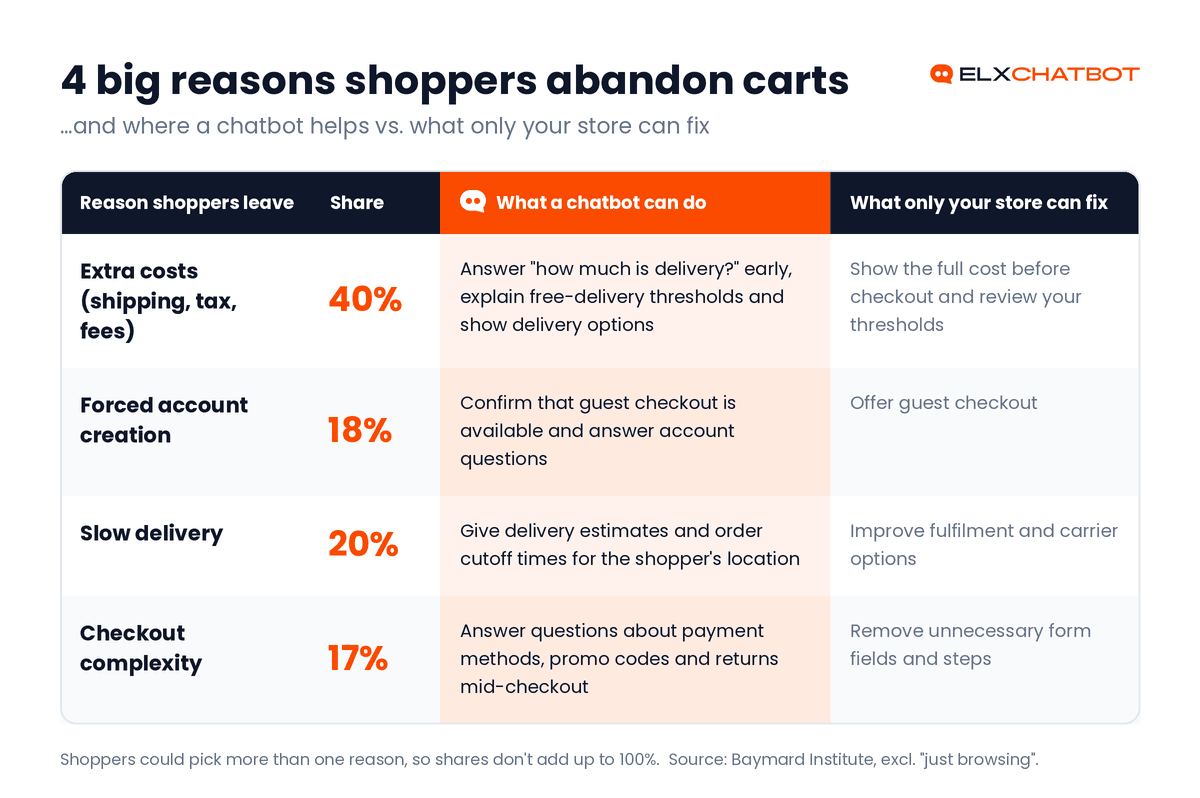
The table shows a limit worth stating plainly. A chatbot answers questions, but it will not remove a mandatory sign-up step or make your delivery faster. Treat it as one part of your conversion work, next to the fixes in the right-hand column.
Four places a chatbot helps
1. Shipping and delivery questions
Extra costs such as shipping are the biggest single reason for abandonment, and shoppers often want a simple answer: how much and by when. When the chatbot knows your delivery rules, it can answer in seconds. ELX Chatbot learns from your FAQ pages, so the answer matches what you publish.
2. Product doubts before the cart
Some abandonment starts earlier, when a shopper is unsure about sizing, compatibility or which option to choose. Product recommendations based on what a shopper says they need can narrow a long catalog to a few suitable options.
3. Questions about returns and payment
Shoppers about to pay often check the return policy or ask which payment methods you accept. A quick answer in the chat window saves them from hunting through your site.
4. Hand off to a person when it matters
For a large basket or an unusual request, a human reply can close the sale. Live handoff lets your team join the conversation with the context already in view.
What improvement could be worth: a worked example
The numbers below are an illustration, not a prediction. Replace them with your own figures.
Monthly visitors: 60,000
Conversion rate today: 2.5%, which gives 1,500 orders
Average order value: $70, which gives $105,000 a month
If better answers lift conversion by 10% in relative terms (from 2.5% to 2.75%), you get 1,650 orders. That is 150 extra orders, or $10,500 more per month. A 5% relative lift would give $5,250.
Some vendors report much larger differences between shoppers who use an AI assistant and shoppers who do not. For example, Fin reports conversion 3x to 4x higher for AI-assisted sessions. Those figures come from vendors and from self-selected sessions, because shoppers who chat may already be more likely to buy. Run your own test before you rely on them. Controlled tests tend to show smaller gains: the same Fin article quotes a preliminary A/B test in which one cosmetics brand saw a 3.4% uplift in revenue per visitor.
How to measure it on your store
1. Set a baseline: Record your conversion rate, average order value and cart abandonment rate for the past 30 days.
2. Compare like with like: Compare chat sessions with non-chat sessions on the same days, and for the same traffic source.
3. Review unanswered questions weekly: Each gap is a question that may have cost a sale. Add the answer.
4. Watch checkout-stage conversations: Questions asked during checkout show you what your pages fail to explain.
The bottom line
Abandonment has several causes, and some of them sit in your store design. But a large share starts with a question that did not get answered in time. Answering those questions quickly, on the page, is one of the more practical ways to recover sales.
Don't let unanswered questions cost you another sale. See how ELX Chatbot helps shoppers find products, get instant answers, and move confidently toward checkout. Start your free trial today.
Sources
More Blogs
Explore more insights, tips, and stories from our team.