AI Chatbots vs Traditional Live Chat for BigCommerce Stores
Discover how AI chatbots outperform traditional live chat for BigCommerce stores
Jun 16, 2026
5 mins
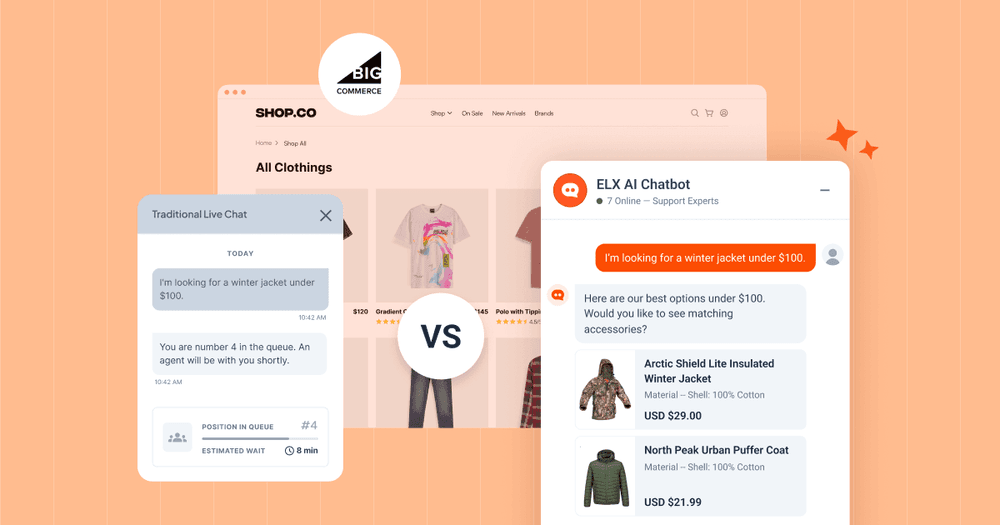
BigCommerce stores have relied on live chat for years to support customers and improve ecommerce conversions. However, AI chatbots are rapidly changing how ecommerce brands engage with shoppers. In this article, we compare AI chatbots and traditional live chat, explore the strengths of both approaches, and explain why conversational AI is becoming increasingly important for ecommerce in 2026.
For many years, live chat has been one of the most effective tools for ecommerce customer support.
It allowed BigCommerce brands to:
- Answer customer questions quickly
- Assist during checkout
- Improve customer satisfaction
- Increase conversions
But ecommerce customer expectations have changed dramatically.
Today’s online shoppers increasingly expect:
- Instant responses
- 24/7 availability
- Personalised recommendations
- Conversational shopping experiences
- Faster buying journeys
Traditional live chat alone often struggles to meet these expectations at scale.
This is why AI chatbots are rapidly becoming one of the most important technologies in ecommerce.
The question for many BigCommerce brands is no longer: “Should we offer live chat?”
The real question is: “How should AI and human support work together?”
What Is Traditional Live Chat?
Traditional live chat connects customers directly with human support agents through a website chat interface.
It is commonly used to:
- answer support questions
- assist with product enquiries
- resolve customer issues
- support checkout journeys
Live chat became popular because it allowed customers to receive faster responses compared to email support.
For many ecommerce businesses, it significantly improved customer experience.
What Is an AI Chatbot?
An AI chatbot is an AI-powered conversational system capable of interacting with customers automatically.
Modern ecommerce AI assistants can:
- Answer support questions
- Recommend products
- Retrieve order information
- Guide product discovery
- Assist during checkout
- Personalise customer interactions
Unlike older scripted bots, modern AI chatbots use conversational AI to understand:
- Customer intent
- Natural language
- Contextual conversations
This allows them to provide more intelligent and personalized shopping experiences.
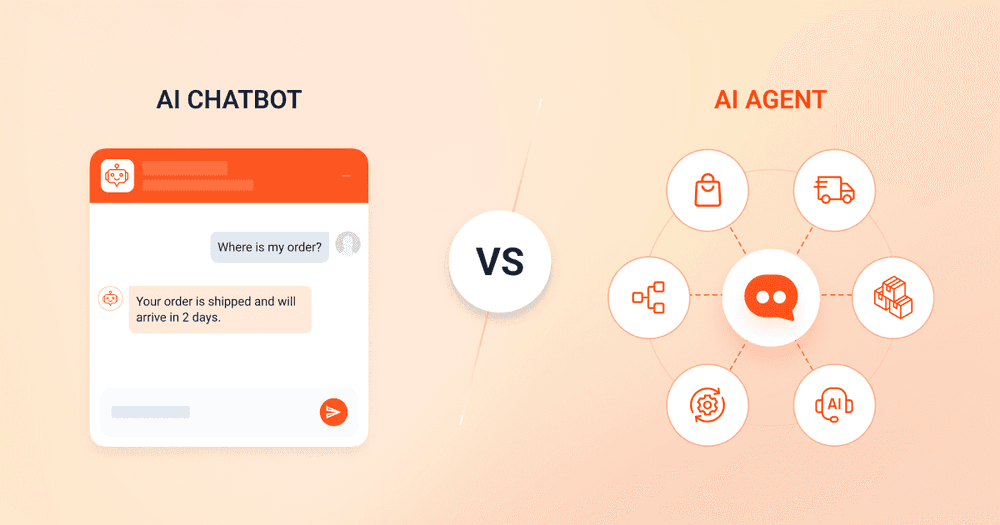
AI Chatbots vs AI Agents: What Ecommerce Brands Need to Know in 2026
The Biggest Difference Between Live Chat and AI Chatbots
The main difference is scalability and automation.
Traditional Live Chat Relies on Human Agents Human agents manually manage conversations one at a time.
This creates limitations around:
- staffing
- support hours
- response times
- operational costs
AI Chatbots Automate Conversations AI assistants can:
- handle multiple conversations simultaneously
- provide instant responses
- operate 24/7
- scale support automatically
This creates much greater operational efficiency.
Why Ecommerce Expectations Are Changing
Customer behaviour has evolved significantly.
Modern shoppers are increasingly used to:
- instant messaging
- conversational AI
- voice assistants
- real-time digital experiences
As a result, customers expect ecommerce websites to feel:
- responsive
- intelligent
- conversational
- personalised
Waiting for a human agent to become available is no longer ideal for many shoppers.
AI Chatbots Provide Instant Responses
One of the biggest advantages of AI chatbots is immediate availability.
Customers increasingly expect instant answers to questions such as:
“Where is my order?”
“Do you ship internationally?”
“What size should I choose?”
“Which product is best for me?”
AI assistants can respond instantly without requiring customers to wait in support queues.
This helps reduce friction during the buying journey.
AI Chatbots Improve Ecommerce Product Discovery
Traditional live chat is mainly reactive. Customers typically contact support only after encountering a problem or question.
AI chatbots can proactively help customers discover products through conversational interactions.
For example: “I need running shoes for marathon training.”
The AI assistant can:
- ask follow-up questions
- narrow recommendations
- explain product differences
- guide customers towards purchases
This transforms the chatbot from a support tool into an AI sales assistant.
Traditional Live Chat Can Become Expensive
As BigCommerce stores grow, live chat support can become operationally expensive.
Businesses often need to:
- hire more agents
- extend support hours
- manage higher ticket volumes
- support multiple regions
AI chatbots help reduce this pressure by automating repetitive customer interactions.
This allows human teams to focus on:
- escalations
- sensitive issues
- complex customer needs
AI Chatbots Operate 24/7
Customers shop online at all times of the day across multiple time zones. Traditional live chat coverage is limited by staffing availability.
AI-powered ecommerce assistants provide:
- continuous availability
- instant support
- Global coverage
- support scalability
This is especially valuable during:
- peak shopping periods
- holiday sales
- international growth
- product launches
Human Support Still Matters
AI chatbots are not designed to replace human support teams entirely.
Human agents remain essential for:
- complex support cases
- escalations
- relationship management
- sensitive customer situations
The most effective ecommerce support strategies combine:
- AI automation
- conversational AI
- human expertise
- seamless handover workflows
This hybrid approach creates the best overall customer experience.
AI Chatbots Help Reduce Cart Abandonment
Cart abandonment often happens because customers:
- cannot get answers quickly enough
- feel uncertain
- hesitate during checkout
- encounter friction
AI chatbots help reduce abandonment by:
- answering objections instantly
- clarifying delivery information
- explaining return policies
- recommending suitable products
- assisting customers during checkout
This improves customer confidence during critical conversion moments.
Conversational Commerce Is Changing Ecommerce
One of the biggest shifts happening in ecommerce is conversational commerce.
Customers increasingly expect shopping experiences that feel:
- interactive
- personalised
- guided
- conversational
AI-powered assistants help BigCommerce stores create these experiences more effectively than traditional live chat alone.
AI Chatbots Provide Better Scalability
One of the biggest operational advantages of AI support is scalability.
AI assistants can handle:
- large conversation volumes
- repetitive queries
- multilingual support
- customer engagement across regions
Without requiring businesses to scale support teams proportionally.
This helps ecommerce businesses grow more efficiently.
AI Chatbots Improve Mobile Ecommerce Experiences
Mobile shopping often creates additional friction because:
- navigation is more difficult
- support visibility is limited
- product discovery takes longer
AI chatbots simplify mobile experiences by allowing customers to ask questions conversationally rather than manually browsing through menus and filters.
This helps improve mobile engagement and conversions.
Multilingual AI Helps International Ecommerce
International ecommerce expansion creates customer support challenges across multiple languages.
AI-powered assistants can:
- detect customer languages automatically
- communicate naturally across regions
- provide consistent customer experiences globally
This is significantly harder to scale using traditional live chat alone.
AI Chatbots Provide Valuable Customer Insights
AI conversations generate valuable data about:
- customer behaviour
- support trends
- conversion barriers
- product confusion
- shopping intent
These insights help BigCommerce brands improve:
- product pages
- customer journeys
- support strategies
- conversion optimisation
Traditional live chat platforms often provide less structured behavioural insight.
What BigCommerce Brands Should Prioritise in 2026
As ecommerce AI technology evolves, BigCommerce stores should focus on solutions that offer:
Conversational Product Discovery
The AI should guide customers naturally through shopping journeys.
Intelligent Recommendations
Recommendations should reflect customer intent and context.
Real-Time Support
Customers increasingly expect immediate assistance.
Human Handover
Businesses should be able to join conversations seamlessly.
BigCommerce Integration
The AI should integrate deeply with products, inventory, and orders.
Analytics and Insights
Understanding customer behaviour is critical for optimization.
The Future Is AI and Human Collaboration
The future of ecommerce support is not AI versus humans. The future is AI and human collaboration.
AI chatbots help:
- automate repetitive tasks
- scale customer engagement
- improve response times
- personalise shopping journeys
Human agents continue to provide:
- empathy
- relationship management
- complex problem solving
The combination of both creates the strongest customer experience.
Final Thoughts
Traditional live chat remains valuable for ecommerce businesses, but customer expectations are evolving rapidly.
AI chatbots help BigCommerce stores:
- improve customer experience
- automate support
- personalise shopping journeys
- reduce cart abandonment
- increase conversions
- scale more efficiently
As conversational commerce continues to grow in 2026, AI-powered ecommerce assistants are becoming an increasingly important part of modern online shopping experiences.
For BigCommerce brands looking to improve both operational efficiency and customer engagement, combining conversational AI with human support is likely to become the most effective long-term strategy.
More Blogs
Explore more insights, tips, and stories from our team.