5 Critical Factors That Make or Break Your AI Chatbot for eCommerce
How response speed, accuracy, and integrations directly impact CX and conversions
Apr 3, 2026
5 mins
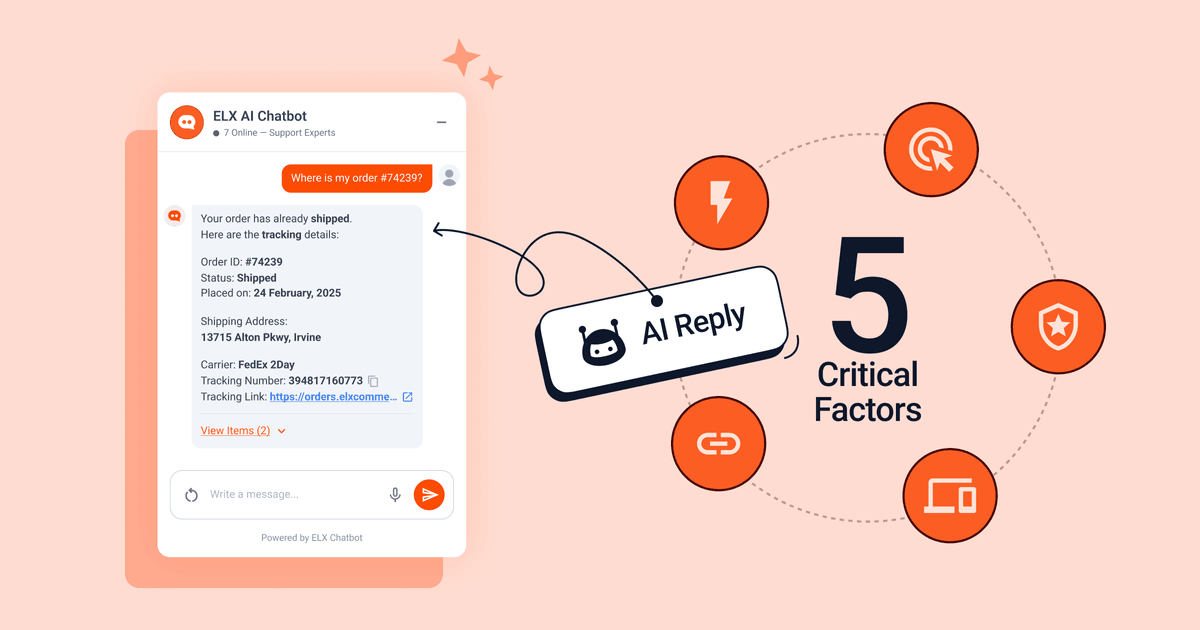
Not all AI chatbots improve customer experience—some drive customers away. Learn the five critical factors that determine whether your eCommerce AI chatbot boosts engagement, builds trust, and increases conversions.
We built our first AI ChatBot back in 2023. This first version of the ChatBot had a simple mission – learn about the business, products that it sells and then answer customer’s questions.
At first, I thought, with the LLM, this should be a very simple thing. Just feed the data to the bot and let LLM do its job to answer questions.
It does, in hindsight, feel simple right?
I couldn’t be more wrong! It is not that straight forward.
Coming from the UX Research background, I had to put this in front of the customer and assess the response. Not only that, but also how long it takes to get the answer back.
1. AI Chatbot Response Time Matters More Than You Think
We as humans are becoming more impatient every day. When a customer asks a question about a product, delivery time, or return policy, they expect the answer immediately. Waiting even a few seconds can feel slow.
Studies show that over 70% of customers expect instant responses when interacting with online support.
In the first version of our chatbot, the average response time was around 13 seconds. During testing, we noticed something worrying: Customers were opening the chatbot, asking a question, and leaving before the answer arrived.
We had to dramatically improve performance and reduce the response time to around 3 seconds.
Speed is not just a technical metric. & It directly affects customer trust and engagement, so we built AI-powered instant response system
2. Speed Should Never Compromise Response Quality
Improving speed created another challenge. It was compromising the quality of response!
The quality of responses must remain high.
Customers expect AI chatbots to provide accurate answers about:
- Products
- Shipping policies
- Returns
- Availability
- Order status
Training the chatbot properly became critical.
Customers can ask the same question in many different ways, and the system must still deliver the correct answer.
This meant we had to completely rethink how we structured the knowledge base and retrieval system behind the chatbot.
3. AI Chatbots Must Know When Not to Answer
One of the biggest lessons we learned came during early testing.
When asked completely unrelated questions, the chatbot still tried to answer them.
That behaviour is risky.
A good AI chatbot must stay within its knowledge boundaries.
We restricted the chatbot to only respond using:
- Website content
- Product catalogue
- FAQ data
- Admin-defined responses
This dramatically improved accuracy and prevented the chatbot from inventing information.
4. Your Chatbot Admin Panel Must Be Easy to Use
One thing that many companies underestimate is the usability of the chatbot admin panel.
Training and configuring a chatbot should not require technical expertise.
We ran multiple usability testing sessions with our clients to understand:
- How they add FAQs
- How they train the bot
- How they configure tone of voice
- How they update product information
This was an absolute eye opener for us – that helped us understand things that made sense and things that did not. These sessions helped us redesign the interface to make it much easier and faster for businesses to set up their chatbot.
5. Integration With eCommerce Platforms Is Critical
Does this AI Chatbot work with our ecommerce system?
Initially, integration required adding a single line of code to the website. Through the admin panel, you train the bot with your product XML feed, you can connect with your Order status API and train the bot with your FAQs.
But we realised we could make the process even easier by building native integrations.
Today, ELX ChatBot integrates with platforms such as:
And we are working on more integrations. Why? Because it makes things faster to implement the ELX ChatBot to those clients.
Final Thoughts
Building an AI chatbot is not just about connecting a large language model to your website.
To deliver a great customer experience, an AI chatbot must:
- Respond quickly
- Provide accurate answers
- Stay within its knowledge boundaries
- Be easy for businesses to manage
- Integrate seamlessly with eCommerce platforms
These lessons shaped the development of ELX ChatBot, and they continue to guide how we improve the platform.
Experience ELX Chatbot today — Book a Demo or Start Free Trial




More Blogs
Explore more insights, tips, and stories from our team.